
-

Call for Papers: Animals at Large: Critical Animal Studies Perspectives on Wild, Feral, and Liminal Animals
Posted by Sally Borrell on 2026-11-17
Animal Studies Journal, Vol. 16, no. 2 (2027)
Guest Editors: Christiane Bailey, Emelia Quinn, Kelly Struthers Montford & Chloë Taylor
Animal Studies Journal invites submissions for a special topics issue on wild and other non-domesticated animals. This issue arises in response to growing recognition of the plight of wild, feral, and liminal animals. As animal ethicist Catia Faria (2023) writes, “the problem of wild animal suffering […] has been traditionally neglected” (7), with animal ethicists and critical animal studies scholars focusing primarily on animals who are more directly oppressed and exploited by humans, such as animals in agriculture and laboratories. In contrast with domesticated animals who have the legal status of property, wild animals have been idealized in animal and environmental studies as “free,” even as global wildlife populations have experienced a catastrophic 73% decline in the 50-year period of 1970 and 2020 as a result of anthropogenic activities. This is problematic, for Faria, because wild animal suffering is considerable and growing and the “number of animals in the wild vastly surpasses the number of animals under human control” (7). Similar views have also been advanced by animal ethicists Oscar Horta (2010, 2022), Kyle Johannsen (2020), and Martha Nussbaum (2023).
While Faria, Horta, Johannsen, and Nussbaum all believe that the scale of wild animal suffering demands human interventions in nature, philosophers such as Sue Donaldson and Will Kymlicka (2011, 2025) and Clare Palmer (2010) have maintained that our primary ethical obligation to wild animals is to leave them alone and repair the harm we have done, such as restoring their habitat. Critical animal studies scholars and animal ethicists have been highly critical of conservationist interventions in nature in particular, as these often involve culls of animals deemed “invasive” (Lorimer 2015; Cummings & Stanescu 2018; Marris 2021; Castelló & Santiago-Ávila 2023). They have argued for learning to co-exist with animals who annoy and frighten us, from urban scavengers (Corman 2011) to big cats (Collard 2012; Pratt-Bergstrom 2015; Mathur 2021). While these scholars debate when interventions in nature are justified, collectively this literature demonstrates that wild and other non-domesticated animal suffering is an urgent ethical and political issue, and that advocating for these animals must be approached differently than for domesticated animals. Animal ethics and politics need to be contextual or take into consideration historical and current relationships between humans and particular animals.
While most of the scholars cited above refer to non-domesticated animals as “wild” or in some cases “liminal” (Donaldson and Kymlicka 2011), other scholars have argued that “wild” has stigmatizing connotations of being irrational or out of control. While this has led some scholars to use the language of “free-living” instead, this term has also been problematized as idealizing the lives of animals that are in fact characterized by desperate struggles to survive in the face of both natural and anthropogenic causes of suffering. In response to these debates over how to refer to animals who are not under direct human control, we put out this call for submissions under the title: “Animals at Large: Critical Animal Studies Perspectives on Wild, Feral, and Liminal Animals.” “At large” is an appropriation of the language of animal control officers, highlighting the criminalization and persecution of animals deemed out of place in human societies if not owned and contained. The title is inspired by an orange tabby cat named Antoine who was repeatedly incarcerated by Animal Control for being “at large” in an urban area, including when he attended the local Pride Parade and Fringe Festival.
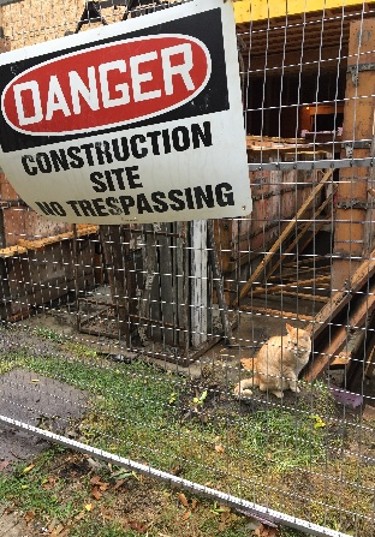
Antoine at large
We welcome submissions on a wide range of topics, from supposedly “invasive” and “pest” animals to wild animal conservation and the transmission of zoonoses from farmed to wild animals. We also welcome multi- and interdisciplinary perspectives from the social, human, and biological sciences, including animal geography, anthrozoology, communication and media studies, conservation biology, criminology, cultural studies, literary studies, philosophical ethics, political theory, and sociology, among others. Creative works are also welcomed.
Manuscripts should be submitted by May 1, 2027 through the Animal Studies Journal website, following the conventions of the journal. See: https://www.uowoajournals.org/asj/submissions/
Back to News List