


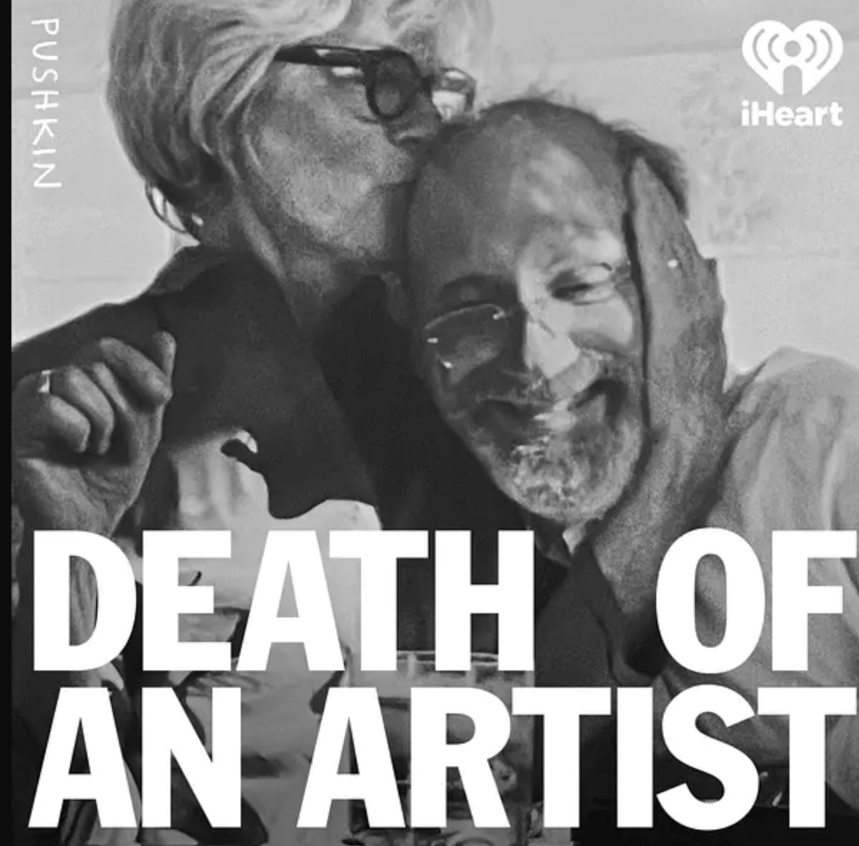
This finely crafted and disturbing podcast explores the mutual suicide of a long-married Oregon couple, Petra and Michael Mathers. Over six episodes (26 to 44 mins), we hear family and friends reflect on the Mathers’ decision, as journalists Leon Neyfakh and Alice Gregory (themselves a married couple) dig into the complexities of their life and death.
This narrative podcast stands out for several reasons. The premise is innately compelling: why would two healthy and happy artists decide to end it, when still only in their late seventies? The structure is unusual, especially for an American production, in that there is no narrator – the story unfolds through the testimonies of those who knew them, leaving listeners to form their own opinions of what happened and why. Production and sound design are superb, the music alternately supporting and probing the deeply affecting content. Add sprinkles of audio gold, from the opening voicemail messages left by increasingly concerned friends to cosy domestic scenes as Leon and Alice read Petra’s books (she was a celebrated children’s author and illustrator) to their toddler daughter, Tess.
This review will examine the series based on aspects of a close analytical listening framework identified by Jorgensen (2023).1 This is deployed in conjunction with an interview I recorded with Leon Neyfakh and Alice Gregory about their process. Relevant audio clips from the podcast are hyperlinked.
The series opens poignantly with Petra’s voice on the answering machine, her German accent evident as she says ‘Hello. You’ve reached Michael and Petra Mathers. Leave us a message. Thank you.’ The messages start jovially, a man singing Happy Birthday, a woman sending good wishes. Tension quickly builds as caller after caller implores them to call back. Finally, someone picks up – not Petra or Michael, but their friend Patty, also the executor of their estate. The caller says he received an alarming letter. Patty sighs, tells him gently, ‘they took their life and that’s the way they wanted to do it. They wanted to go together and, and that’s what they did.’
This opening montage segues to a family scene, as Leon and Alice read one of Petra’s books to two-year-old Tess. They didn’t include Tess lightly. ‘It could be (a) cloying, and (b) quite jarring in a story about suicide, including a child,’ Alice reflects. [But] ‘it just felt like the most organic way to introduce the fact of her writing these children's books and how we came to the story – and the fact that we do read these books actually to our daughter. But yeah, I can see it being off-putting for sure.’ ‘We've gotten a few comments, like on Apple podcasts, saying, does anyone else think this baby is not a value-add?’ says Leon, laughing. But these realistic family moments also provide a metaphorical contrast to the warmth that we will learn is so absent from Petra’s own maternal relationship.
Now an older male voice tells us the reading is from Petra’s classic, Sophie and Lou. Another man chimes in. These are ‘the two Michaels’, who brought the Mathers together, some 44 years before. With the to-and-fro of a couple used to finishing each other’s sentences, Michael #1 and Michael #2 piece together for us Petra and Michael’s all-consuming romance. ‘You’re jumping way ahead’, complains Michael #2, leaving Leon to steer: ‘Just start at the beginning.’
While they loom large as host-interviewers, neither Leon nor Alice takes on a formal narrator role. This lack of narration is especially striking in Leon’s case, because his previous well received audio documentary series (Slow Burn, Fiasco) were characterised by particularly dense narration – ‘a relic of me being a print writer’, he acknowledges (he started at the New York Observer and The Boston Globe). Alice had a magazine-writing background (The New Yorker, Harper’s) – Death of an Artist (DOA) is her first venture into audio. So how did DOA’s montage structure evolve? ‘We had the fantasy pretty early on’, says Leon. ‘We didn't know it was going to work until like, the third rough cut of episode one, we felt, okay, we can pull this off.’
Non-narrated montage
The rationale was simple, but sound. Leon notes: ‘there's not that much plot in this story... complexity comes from how people feel about it and what they think. It's a lot about emotion. And so I think we were a little at a loss as to what we would add to it, as narrators. I suppose we could have narrated our reporting process: “and then we went to talk to so-and-so”. But that didn't seem that important. I think we also felt that any narration that we could have supplied, would have necessarily felt too hand-holdy.’
This was a bold but excellent decision. So often, podcast hosts spoon-feed listeners didactic reprises. But good narration is oblique, sidling up to a plot twist or countering an expectation. In DOA, the emotive subject matter was the heart of it all and needed space to gather heft. ‘We didn't want to tell people what to feel or think,’ says Leon. ‘And when you don't have a lot of plot to explicate, that's sort of all you would have left. And so it just felt much more intuitive to both of us to just let people speak for themselves.’
Not that it was that easy. As audio documentary-maker and scholar David K. Dunaway has observed, ‘selection is the heart of art’ (Dunaway 1984:340). Audio producers create meaning by which interview extracts they choose to include/exclude, how they sequence them, and how they pace and modify them by layering them with music or ambient sound. They might also use abutting scenes as transitions to new story beats. It’s an approach sometimes described in the industry as being ‘led by tape’ (recordings). Here, Leon explains, the pair ‘exert a lot of editorial control in terms of the order in which people appear and how we edit their interviews and what we juxtapose’.
At an aesthetic level, Leon also wanted to experiment with storytelling forms. ‘All the shows I've ever made, clarity has been the number one priority. I've always felt enormous pressure to make every sentence, every paragraph, be totally clear. Don't leave any room for confusion on the listener's part. [But] I'd become conscious that when I would watch a movie or read a novel, a substantial part of the experience is figuring out what's going on. And all of that information is unspooled gradually and deliberately. And I think the work of putting the pieces together is a huge part of the pleasure and what binds you to the story and makes you invested and immersed in it. And so I felt jealous of that. I've never been able to conjure that experience in audio. So much of the stuff I've done has been historical and policy-related or political. There's stuff to explain and background to give.’ But DOA was much more character-driven, a study of relationships, family, psychology. ‘You get out of the way and let our interviewees say something that maybe isn't entirely clear right away but becomes clear later. And so we wanted to kind of plop people into the middle of it and have them find their way.’
In Episode 2, we meet Patty’s sister, Ginny. It was Ginny and her husband who introduced Patty to Petra and Michael, some forty years before. Ginny wonders aloud if Patty knew in advance of the date they’d decided to die. Patty reveals she didn’t, but she had an inkling when the couple let something slip. ‘He gave me this sort of look, and I figured, okay. You know, it was gonna be sooner than later,’ Patty says. The interplay between the sisters builds, key moments accentuated by a musical pause. Ginny castigates herself for not having picked up on hints. She becomes anguished (Ep 2, 31.24): Listen
GINNY: I would have gone to great lengths, had I known, had I known
LEON: What would you, what would you have said?
GINNY: I would've screamed. I would've shouted. I would've cried out. I would've protested. I would've given a million reasons to not leave this world.
ALICE: Maybe they knew that.
GINNY: I think they did. I think they must have. Why didn't they tell us? Why didn't they tell us?
Joint interviewer dynamics
Having ‘one married couple trying to understand another’, as the blurb notes, adds another dynamic. ‘A lot of people found an elegance or something in the symmetry of one couple writing about another,’ muses Alice. At a practical level, she found it enjoyable. ‘I've only ever written magazine pieces, where you're alone for months. So it was amazing to have the experience of someone finishing your thoughts and thinking to ask things that you didn't ask. And debriefing immediately afterwards felt very luxurious.’ The pair complement each other well. Looking through Petra and Michael’s photo albums, Alice starts off describing Michael’s ‘Tom Wolfe-ish suit’, then comments: ‘She's in a dress that I wish I owned’ (Ep 2, 14.55). She laughs, and Leon joins in. It’s one of those authentic moments that develops the parasocial relationship with listeners, who scholars tell us, crave self-disclosure by the host (Have and Heiselberg 2023).
They did not over-plan these joint interviews. ‘We had an idea of who was going to ask what, but often that was determined by nothing more interesting than who had been doing the logistical legwork,’ explains Alice. In the moment, they played it by ear. ‘I think it kind of wordlessly would become apparent to one or both of us, who was having better luck.’ But sometimes, Alice recalls, ‘gender played a role. Certain people seemed like they would be more excited to talk to a man or a woman.’
In Episode 4, one of Michael’s male college friends, Locker, regales Alice with nostalgic tales of Michael as charismatic rebel and elite sportsman. Another, Don, describes how young Michael lived in a converted coffin factory and they’d all ‘go there for dates and shack up’. ‘He was good with girls?’ asks Leon, picking up on the blokey vibe. ‘Oh yeah’ says Don. As they discuss the photo albums with Ginny, Leon is trying to penetrate the surface imagery of this Perfect Couple. ‘There's like a sustained sense of infatuation, which you would imagine under normal circumstances goes away after some amount of time’, he says. Alice goes further. ‘Obviously it’s a curated presentation, they weren't including pictures in their photo albums of them looking bored or unhappy, but I mean, I felt jealous of them just looking at the photos, and I had never even met them.’ This resonates hugely with Ginny (Ep 2, 20.22).
GINNY: Oh, thank you, Alice. Yeah, so you, you appreciate what I mean? Yeah.
ALICE: Oh yeah, yeah, yeah
GINNY: Yeah, you're right. That's exactly right. Like they were always, the whole entire time they were courting each other, and they never wanted to disappoint, really, one another…
Episode structure
Episodic structure is masterfully designed. In a pattern reminiscent of Japanese film director Kurosawa’s classic, Rashomon, each episode delivers a radically different perspective on the double suicide (or murder-suicide, as it technically is). Michael kills Petra first, we learn, then places her on the bed and kills himself – not before he makes some adjustments, such as seemingly tearing up photos of Petra looking beautiful (Ep 2, 34.01):
PATTY: There was a big cup of coffee, half a cup of coffee up there in the kitchen when I came in and, and those ripped pictures. So I think, did he have a cup of coffee? Did he come down and rip these pictures up? You know. Don't know.
[music/transition]
Episode 1 sets up the couple and their choice, in glowing terms. Episode 2 teases out the conflicting views of the sisters, Patty and Ginny. Episode 4 is a mostly adulatory celebration of young Michael by his old college mates, though an ex-girlfriend, Birdie, adds a less starry-eyed note, saying he jilted her. Episode 5 takes us to the actual memorial, where we meet Michael’s siblings Ursula and Myra for the first time. This gives us a much more nuanced view of the family, with its overbearing patriarch and a mother who dies horribly with dementia. It also covers Petra’s life in Germany: her half-brother and his wife, who was very close to Petra; her unhappy previous marriages; her parents’ wish to have voluntary euthanasia, albeit in their nineties. Episode 6 is an anatomy of the whole event, which includes fresh viewpoints and provides a sense of resolution. Each episode flips and deepens the previous narrative, raising new questions. But it is Episode 3 that upends everything.
In Episode 3, we meet Petra’s only child, Til (short for Tillmann). With notably flat affect, he chronicles his mother’s serial betrayals. His parents divorced when he was five and after Petra remarried, for pragmatic visa purposes, the next period was the happiest he can remember: ‘it was my mom and I. We were the most important things in each other's lives.’ That all changed when Til was 13 and Petra dumped his stepfather, David. ‘My mom leaves for Michael… is all about Michael … David just crawled into a bottle and never came out.’ Petra and Michael temporarily moved to Singapore. ‘My mom was so enamoured with Michael that I was just like this third wheel,’ he recalls, a melancholic undertow in his voice. Petra started creating her signature books, featuring Lottie the charming chicken and Herbie, the faithful duck. ‘It really struck us that she only started writing children's books after she left her child,’ says Alice. ‘Yes. I never really kind of caught the irony of that until you said it,’ replies Til. Earlier, he muses: ‘I don't know that my mom ever really liked children.’ In time, Til finds love with his wife Brenda. When he’s about 32, Michael formally adopts him. ‘I was excited that he wanted to, you know, see himself as my father.’ But the brief rapprochement goes pear-shaped when Til’s son Jake is born. ‘My mother had a lot of opinions of how I should raise my son… that created a wedge, and that wedge just kind of kept getting bigger and bigger.’ Petra and Michael write to Til: he’s been cut out of their will.
Til learns of their death like everyone else – through the mail. He reads Michael’s letter (Ep 3, 33.30-34.28, abridged). Listen:
‘Dear Til, by the time you get this, your mother and I will be dead… We wish you the best for the rest of your life… For the record, our conflict with you had nothing to do with our decision. Best, Michael.’
The casual ‘best’ still jars. Petra’s letter was worse.
‘I have never regretted my decision, only the amount of unhappiness it caused you. Still, unforgivingness is the product of those who feel it. The uncountable times I think of you, I remember all the years when the going was good. Love, Mommy.’
There is no music – just the rustle of the paper and a heavy sigh. We need to feel the full naked force of the hurt. It goes on (Ep 3, 36.19). Listen:
TIL: It was sad that those were the last thoughts that were given to me.
LEON: The line about unforgivingness is a product of…
TIL: Those who hold it.
LEON: That feels like a just, kind of getting the last word.
TIL: Yeah, it is.
Sombre music seeps in, as the stakes escalate (Ep 3, 40.03): Listen:
TIL: I believe that this was Michael's plan all along, and my mother decided to go along with it rather than be alone.
LEON: Do you think of him as having killed her?
TIL: Yes, I do. I hold Michael responsible for my mother's death.
The music swells, mirroring Til’s pain and anger.
By the end of this pivotal episode, many listeners will have gone from some empathy for Petra to considering her selfish and cruel, with Michael a manipulating Svengali. The placement crucially informs interpretation of the remaining three episodes – yet initially, Leon thought Til should go last. ‘I think that was my instinct in large part because he was one of the last people we interviewed… he was reluctant to speak to us for a while.’ Luckily, other editorial voices, such as supervising producer and editor, Diane Hodson, and producer Sonya Gurwitt prevailed. ‘We were both ultimately persuaded that if we did put him last, it would end the series on such an unambiguous note, and people might've felt misled to have gone on this journey… my hope is that you can kind of get back from the ledge a little bit as you listen (on).’
Music and production
Throughout the series, the music is beautifully judged, in tone and placement. At times a low growl or a plaintive bed, it also features plucked chords, suggesting optimism. It was composed by Evan Viola, a Pushkin Industries stalwart. A post he made about the podcast reveals his deep immersion: ‘It's not true crime, it's not narrated, it's something artful, smart and funny, yearning and wholesome. It's a poem of a couple enraptured with one another, and an investigation into their constellation of friends, family and overall, the reverberations of their mutually (or maybe not) agreed upon suicide.’2
‘It was a real challenge, to find melodies and chords and notes that didn't scan as happy or sad, but somehow both or neither,’ observes Leon. ‘We talked a lot about how the music kind of took the place of narration,’ recalls Alice. ‘It was much more crucial than it might've been in another show… the music is kind of unresolved in places.’ As with most quality narrative podcasts, the final mix was down to teamwork. ‘It was pretty collaborative and iterative. We went back and forth on every choice,’ Alice explains. Creative sound design and polished production advance the narrative very effectively: e.g. this economic sequence halfway through Episode 5 (19.35–22.27) moves adroitly yet empathetically from Michael’s sister Ursula cataloguing their mother’s ghastly descent into dementia to a fresh chapter featuring brand-new interviewees, Petra’s half-brother, Gero, and his wife, Liane. It starts with Ursula describing how her mother thought her own husband was an intruder trying to sexually assault her. With utmost delicacy, it uses brooding music and silence to traverse Ursula’s shift from briskly clinical recounts to an unexpectedly vulnerable moment, sympathetically navigated by Alice, as Ursula, suppressing a sob, acknowledges the awful indignities (The fade-to-black also allows for a ‘mid-roll’ insert of a commercial). Listen: At other times, the podcast uses mini-montages to render the posthumously delivered suicide letters the pair mailed to their friends and family. Individual recipients read them out, with differing degrees of emotion, but always compellingly. Sometimes we hear one at length, at other times they are intercut, a cascade of terrible snippets, such as here in Episode 6 (17.32–19.29). As music takes over, the final chords convey resolution, at last, though one wavers, like a dubious afterthought. Listen:
The serendipitous ending
So how to resolve the kaleidoscope of emotions the series uncovers? The oceanside cemetery the couple chose is an obvious place to end, given added symbolism because the place, Oysterville, is the setting for Petra’s Lottie books. As Leon and Alice approach the grave with their daughter, Leon asks Tess if she knows what the stones are. She aces it: ‘People going to bed.’ As the parents check out the inscription on the striking white gravestone – “Michael Mathers, 1945 through 2024. Petra Mathers, 1945 through 2024”– Tess spots movement. Unbelievably, it’s a… chicken. ‘If my attention hadn't been called to it by like a child’s scream, would I have even noticed the chicken?’, Alice wonders. ‘Probably, but like, maybe not.’ This ‘completely serendipitous’ chicken provides the perfect ending – a stand-in for Lottie, a metaphor for crossing the road/life-death divide and even, obligingly, a raucous clucking sound. ‘Someone asked if we had added the sound effect after and we were so scandalised,’ Alice recalls. ‘We're like, no, of course not. We would have never even been able to think of this! No, we were just leaving the cemetery and there was a chicken crossing the road.’ The scene dissolves into a swelling bed of music that holds us for 38 seconds – a merciful chance to process our emotions and reflect, before the credits arrive.
Death of an artist: season three - Hosts, reporters, producers: Leon Neyfakh and Alice Gregory. Producer: Sonya Gurwitt. Supervising producer and editor: Diane Hodson. Show-runner: Alexandra Garretón. Executive producer: Jacob Smith. Original music and sound design: Evan Viola. Fact checker: Annika Robbins. Additional production support: Julien Collet. Show art: Shawn Carney. Publisher: Pushkin Industries
Audio and website: https://www.pushkin.fm/podcasts/death-of-an-artist
Author details
Siobhán McHugh is a seminal podcast studies scholar and producer of acclaimed narrative journalism podcasts, who founded RadioDoc Review to develop critical analysis of crafted audio storytelling. Her book, The Power of Podcasting: Telling Stories Through Sound (Columbia University Press 2022) analyses the aesthetics and production practices of narrative podcasts. She has published widely on the affective power of audio storytelling and the impact of podcasting as a new medium. Narrative podcasts Siobhán co-produced include The Greatest Menace, about a gay prison experiment in Australia, which has won 17 major awards, while her other investigative podcasts have won six gold awards at New York Festivals. She is Associate Professor (Honorary) of Journalism, University of Wollongong, Australia.
References:
Dunaway, D. K. (1984). Radio and the Public Use of Oral History. Oral History: an Interdisciplinary Anthology, 333-346.
Heiselberg, L., & Have, I. (2023). Host qualities: Conceptualising listeners’ expectations for podcast hosts. Journalism Studies, 24(5), 631-649.
Jorgensen, B. (2023). Using a “critical ear”: Developing a practitioner–researcher framework for analytical listening in podcast studies. The Bloomsbury handbook of radio, 151-168.
↩︎1 These include using standardised evaluative criteria developed by RadioDoc Review (scroll down here), drawing on a perspective derived from the author’s own narrative podcast production and research background, and employing a self-reflexive approach that included recording observations while listening and re-listening.
2 Post at Linked-In, 23 September 2026. https://lnkd.in/p/gtf5y_uK↩︎